
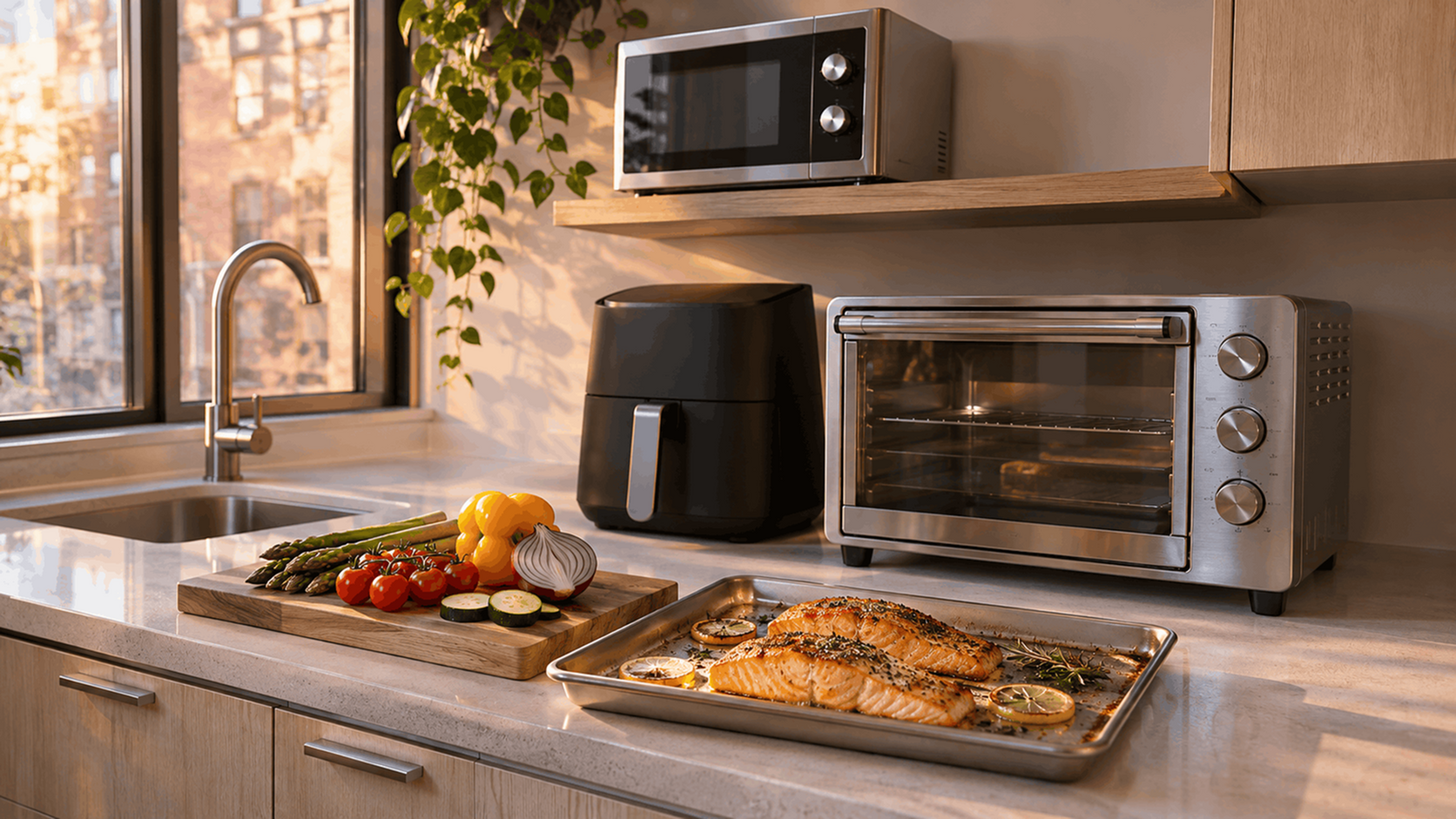
Quick Answer: A small-appliance guide for a studio with no oven comes down to two core machines. A countertop oven handles baking and roasting, while a microwave covers fast reheating. Add an air fryer if you love crispy food, then an induction burner or multi-cooker for stovetop meals, and most everyday recipes are back on the menu.
No oven? No problem. This small-appliance guide for a studio with no oven shows which countertop machines earn their space and what you can realistically cook with them. Here in Northwest Houston, Vivo Living Willowbrook serves renters near FM 1960 and Highway 249 with all-bills-paid studio living, and a compact kitchen should work as hard as your square footage does.
What Is the Core Small-Appliance Setup for a Studio With No Oven?
The core setup is a countertop oven plus a microwave, with an air fryer or a single burner added once you know how you cook. Together they cover the baking, roasting, reheating and simmering a full range would normally handle, and every one of them plugs into a regular wall outlet.
Countertop Oven or Toaster Oven: Your Real Oven Replacement
Start here. A good countertop oven toasts, bakes, broils and roasts, which makes it the closest thing to a full oven you can fit on a counter. Larger convection models take a small sheet pan or a frozen pizza. A basic toaster oven is better suited to toast and single portions.
The savings are real, too. As of November 2026, the U.S. Department of Energy's Energy Saver kitchen guidance says a toaster or convection oven uses one-third to one-half as much energy as a full-sized oven. In a studio, a smaller appliance also means less heat pouring into the room on a hot Houston afternoon.
Air Fryer Meals Without the Wait
An air fryer is really a compact convection oven with a stronger fan. It skips most of the preheat and turns out wings, roasted vegetables, salmon fillets and leftover pizza with crisp edges in minutes. The tradeoff is capacity. Basket models suit one or two people, and cooking for guests means running batches back to back, which can wipe out the energy advantage.
A Single Burner or Multi-Cooker for Stovetop Meals
Pasta, eggs and stir-fry still need a pan. A portable induction burner handles that job well, and the Department of Energy notes that induction is now the most efficient stove technology available. Induction only works with magnetic cookware, so test your pans with a fridge magnet first. A multi-cooker is the other route. It pressure cooks, slow cooks and sautés, so soups, rice and chili get done without you standing over a pot.
Which Appliance Should You Buy First for a Small Kitchenette?
Buy the countertop oven first, then the microwave, then whatever matches your cooking habits. Most renters in a small kitchenette end up with two or three machines rather than six, so each one has to earn its counter space.
| Appliance | What It Replaces | Best For | Space Tip |
|---|---|---|---|
| Countertop or toaster oven | Full-size oven | Baking, roasting, broiling | Keep vents clear on all sides |
| Microwave | Oven reheating | Leftovers, steaming, defrosting | Set it on a sturdy shelf to free the counter |
| Air fryer | Deep fryer, small roasts | Crispy food for one or two | Store it in a cabinet between uses |
| Induction burner | Stovetop | Pasta, eggs, sautéing | Slides flat into a drawer |
| Multi-cooker | Stockpot, slow cooker | Soups, rice, batch meals | A smaller pot size suits one person |
| Electric kettle | Pot of boiling water | Tea, oatmeal, instant noodles | Smallest footprint of the group |
| Starter pair for most studios | Oven and reheating basics | Countertop oven plus microwave | Add a third machine after a month of cooking |
One caution before you plug everything in. Running a countertop oven and an air fryer on the same circuit at once can trip a breaker, and the U.S. Fire Administration's cooking fire safety page advises against extension cords for kitchen appliances. The same agency reports that unattended equipment was the leading factor in nonconfined home cooking fires, at 37 percent. Stay close while food cooks, and check the community FAQs or ask the leasing office about any appliance rules before you set up.
Can You Bake Without an Oven in a Studio?
Yes. You can bake without an oven using a convection countertop oven, an air fryer or a multi-cooker with a baking setting. Smaller pans are the main adjustment. Cookies, muffins, brownies and banana bread all turn out well, while a big holiday roast is better left to a friend with a full range.
Easy Recipes Not Using an Oven
Some of the best recipes not using an oven need no heat at all. Overnight oats and grain bowls built around a store-bought rotisserie chicken carry a lot of weeknights. For hot meals, try these:
- Air fryer salmon with frozen green beans, cooked together in one basket
- Multi-cooker chili that covers four or five lunches
- Toaster oven quesadillas or flatbread pizza
- Microwave scrambled eggs or a mug cake for dessert
A few studio kitchen essentials make all of this easier: a food thermometer, a quarter sheet pan, one good skillet and a stack of microwave-safe glass containers.
Is There a Microwave Alternative Worth Owning?
It depends on what you use the microwave for. For reheating leftovers, a countertop oven or air fryer is a strong microwave alternative because it brings back the crisp edges a microwave can't. The USDA Food Safety and Inspection Service explains in its microwave cooking guidance that microwaved food doesn't normally brown, since the air inside the oven stays at room temperature. The agency also warns that microwaves can heat unevenly, so let food stand after reheating and confirm it reaches 165°F with a thermometer.
Still, no microwave substitute matches it for speed. Softening butter or warming coffee takes seconds, so most renters keep one anyway.
Frequently Asked Questions
1. Is a toaster oven or an air fryer better for a studio with no oven?
A toaster oven is the more flexible pick because it bakes, broils and fits small standard pans. An air fryer is faster for crispy food but holds less. If you only have room for one machine, an air fryer toaster oven combo covers both jobs in a single footprint.
2. Can a countertop oven replace a full oven?
For one or two people, mostly yes. A countertop oven handles roasting and broiling, plus most everyday baking, for normal portions. It struggles with large items like a whole turkey, and you'll cook in batches when hosting. For daily meals, most studio renters find they rarely miss a full-size oven.
3. What are the must-have studio kitchen essentials?
A compact kitchen runs best on a short list of reliable tools:
- A convection countertop oven
- A microwave
- A single burner and one good skillet
- A food thermometer
- Microwave-safe glass storage containers
4. Do small appliances use less electricity than an oven?
Generally, yes, for small meals. The Department of Energy says toaster and convection ovens use one-third to one-half the energy of a full-sized oven. The gap shrinks when you run several batches back to back, so on a big cooking day a full oven can come out about even.
5. Is it safe to use several small appliances at once in an apartment?
It can be, with care. Spread high-wattage appliances across different outlets, plug them straight into the wall instead of an extension cord, and never leave them running while you're out. Keep vents clear of paper towels and mail.
Conclusion
A small-appliance guide for a studio with no oven really comes down to one rule: buy for the way you actually cook. Start with a countertop oven and a microwave, live with them for a few weeks, and add an air fryer or burner only if you keep wishing you had one. If you're comparing studio apartments in Northwest Houston, browse the Vivo Living Willowbrook amenities while you plan a small kitchen that cooks like a big one.